



menu
×

UG Programme

BE CSE (Artificial Intelligence & Machine Learning)

About the Course

Established in the year 2024, the CS&AI Department offers a 4-Year B.E-CSE (AI&ML) Degree course with an annual intake of 60 students.

The main objective of the Course is to impart the knowledge of the fundamentals, techniques, and tools of Artificial Intelligence (AI) and Machine Learning (ML) for creating intelligent systems that cover supervised, unsupervised, reinforcement learning, neural networks, natural language processing, and computer vision. This programme is designed to train graduates in emerging technologies through development of novel ideas for designing and building the intelligent models and formulate systematic solutions to concrete problems in the field of Robotics, Computer Vision, Natural Language Processing, and Cybersecurity, etc.

Job roles for the students graduating from this programme are AI Engineer, Robotics Engineer, Natural Language Processing (NLP) Scientist, NLP Engineer, Automation Engineer, Cybersecurity Analyst, Machine Learning (ML) Architect, ML Engineer, Applied ML Engineer, and Software Developer/Engineer with expertise in Machine Learning.

Vision

To nurture competent, innovative and ethical professionals in Computer Science and Artificial Intelligence who leverage emerging technologies to address global and societal challenges.

Mission

DM1: To provide quality education in Computer Science, Artificial Intelligence, Machine Learning and emerging technologies through innovative teaching earning practices and an industry-oriented curriculum.
DM2: To enhance technical, analytical, research, and professional skills among students through innovation, entrepreneurship, industry collaboration and lifelong learning.
DM3: To nurture ethical and socially responsible professionals who apply advanced technologies for sustainable solutions and societal development.

img

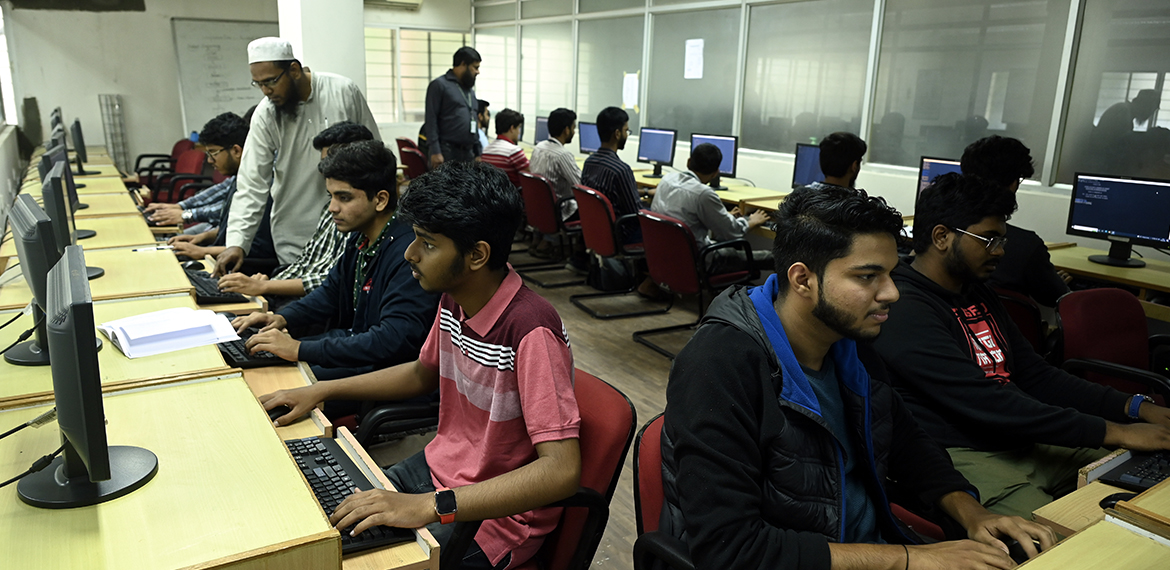
Laboratories for the course

Program Education Objectives (PEO's)

  • PEO1: Graduates will have the capability to apply their knowledge and skills gained to solve the real world problems.
  • PEO2: Graduates will have lifelong learning skill, innovation and creativity to excel in cutting edge technology.
  • PEO3: Graduates will have the ability to apply acquired knowledge to improve the society.

Program Outcomes (PO's)

Graduates will be able to:

  • PO1: ENGINEERING KNOWLEDGE
    Apply the knowledge of mathematics, natural science, computing, and engineering fundamentals and an engineering specialization to the solution of complex engineering problems.
  • PO2: PROBLEM ANALYSIS
    Identify, formulate, and analyse complex engineering problems, reaching substantiated conclusions with consideration for the holistic nature of the problem 
  • PO3: DESIGN/DEVELOPMENT OF SOLUTIONS
    Design creative solutions for complex engineering problems and design systems, components, or processes to meet identified needs with consideration for public health and safety, and cultural, societal, and environmental factors. Sustainability is now intrinsic to design.
  • PO4: CONDUCT INVESTIGATION OF COMPLEX PROBLEMS
    Conduct investigations of complex engineering problems using research-based knowledge and research methods, including design of experiments, analysis and interpretation of data, and synthesis of information to provide valid conclusions.
  • PO5: ENGINEERING TOOL USAGE
    Create, select, and apply appropriate techniques, resources, and modern engineering and IT tools, including prediction and modelling recognising their limitations to solve complex engineering problems.  
  • PO6: THE ENGINEER AND THE WORLD
    Analyse and evaluate societal and environmental aspects while solving complex engineering problems, considering their impact on sustainability with reference to economy, health, safety, legal frameworks, culture, and the environment. 
  • PO7: ETHICS
    Apply ethical principles and commit to professional ethics, human values, diversity, and inclusion; and adhere to relevant national and international laws
  • PO8: INDIVIDUAL AND COLLABORATIVE TEAM WORK
    Function effectively as an individual, and as a member or leader in diverse and multi-disciplinary teams.
  • PO9: COMMUNICATION
    Communicate effectively and inclusively within the engineering community and with society at large comprehending and writing effective reports and design documentation, and making effective presentations considering cultural, language, and learning differences.
  • PO10: PROJECT MANAGEMENT AND FINANCE
    Apply knowledge and understanding of engineering management principles and economic decision-making, and apply these to one's own work, as a member and leader in a team, to manage projects in multi-disciplinary environments
  • PO11: LIFE-LONG LEARNING
    Recognise the need for, and have the preparation and ability for, independent and life-long learning, adaptability to new and emerging technologies, and critical thinking in the broadest context of technological change.

Program Specifice Outcomes (PSO's)

  • PSO 1:
    Apply principles of Artificial Intelligence, Machine Learning and emerging technologies to design and implement intelligent, secure and scalable solutions for real-world problems while adhering to ethical and responsible AI practices.
  • PSO 2:
    Utilise modern AI tools and software engineering practices to foster sustainable solutions for innovative applications and adapt to evolving technologies through lifelong learning.